
Key points from this guide
- Odometer rollback — winding back the kilometre reading to make a car look less used — is one of the most common frauds in India's used-car market.
- Dishonest sellers do it in minutes with cheap OBD tools sold openly for a few hundred to a few thousand rupees, marketed as "ECU correction" or "diagnostic" devices.
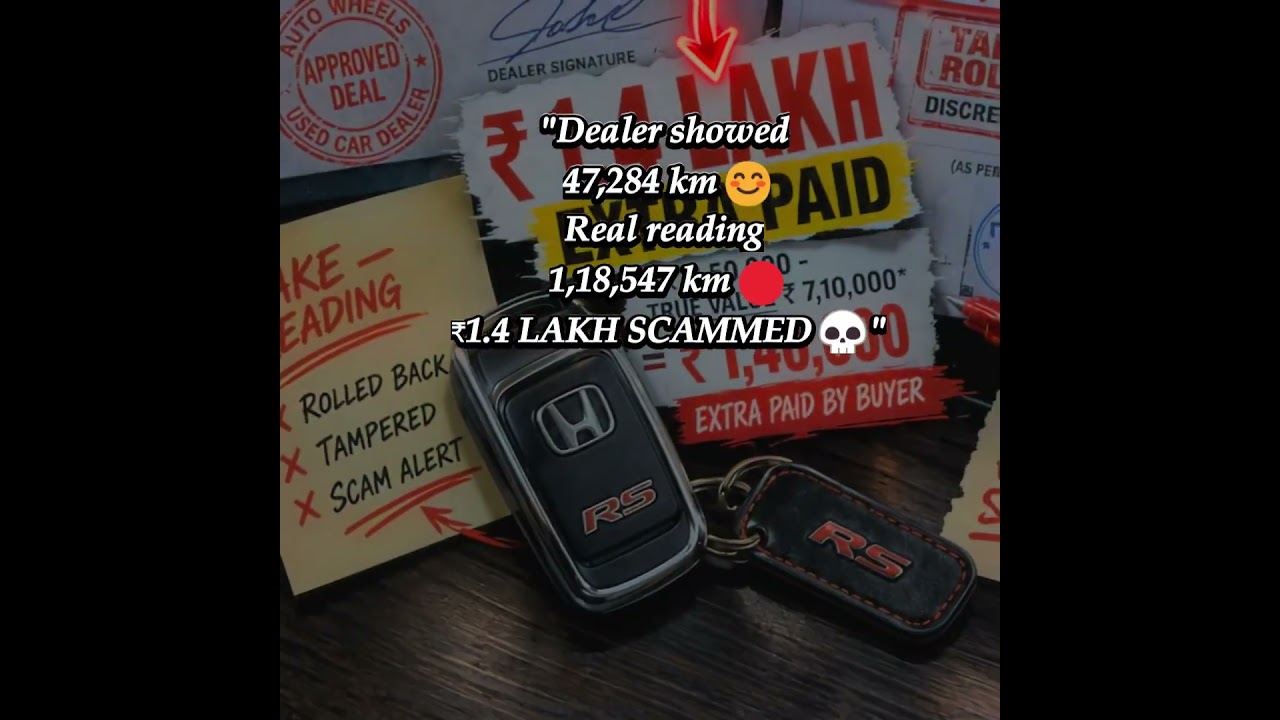
- A typical rollback on a 7-year-old car drops it from around 1,20,000 km to 55,000 km and adds ₹1.5–2.5 lakh to the asking price — money straight out of your pocket.
- India has no specific law against odometer tampering. Your only routes are a cheating case under BNS Section 318 (which replaced IPC 420) and the consumer courts.
- Most rolled-back cars can be caught by combining checks: a full-system diagnostic scan comparing the mileage stored in the car's different modules, the service history, and a few minutes looking at pedals, seats and tyres.
You are looking at a 2019 hatchback. The dashboard reads 38,000 km, the seat covers are spotless, and the price feels like a steal. Three weeks after you pay, the service centre pulls up the car's history and tells you it has actually done over a lakh kilometres. You didn't get a deal — you overpaid by more than a lakh for a tired car, and you have almost no easy way to get that money back.
This is not a rare horror story. Odometer rollback is one of the most common forms of used-car fraud in India, and the rise of digital dashboards made it easier, not harder. Here is exactly how the scam works, why it is so widespread here, and the checks that let you catch a tampered car before you hand over a single rupee.
What Is Odometer Rollback?
The odometer records the total distance a car has travelled in its lifetime. That number is the biggest single factor in a used car's price after its age — a car showing 40,000 km sells for far more than the same car showing 1,20,000 km. Rollback is the act of falsely lowering that reading to inflate the car's value.
 Spotting odometer fraud in a used car
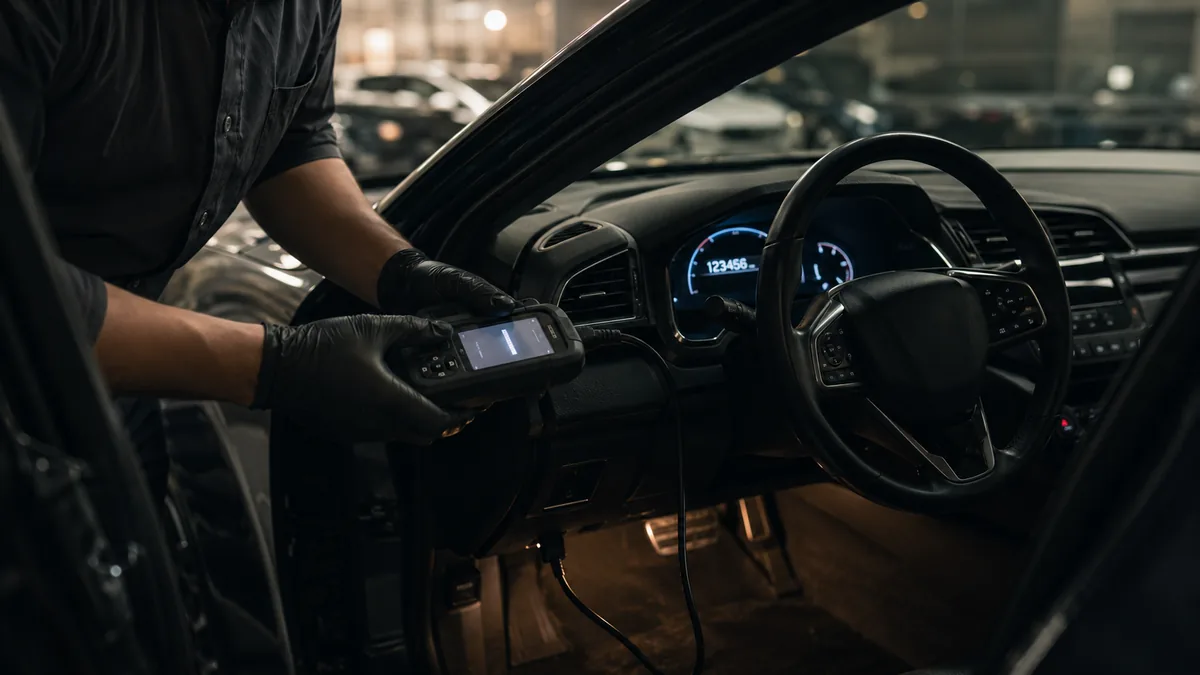
On old mechanical odometers, this meant physically spinning the dials backward. On today's digital clusters, it takes a laptop or a small handheld tool, the right software, and a few minutes plugged into the car. The car looks newer, drives the same, and hides its real wear — which is exactly the problem, because worn-out parts on a "low-kilometre" car start failing soon after you buy.
How the Scam Actually Works
Here is the part most buyers don't understand, and it's also what saves you.
Modern cars don't store the mileage in just one place. The figure on your dashboard is mirrored in the engine control unit (ECU), and on many cars in the transmission module, the body control module, even the keys. Cheap rollback tools usually rewrite the cluster — the number you see — but often fail to overwrite the copy stored deeper in the ECU.
That gap is the fraudster's weakness. When a workshop runs a full-system diagnostic scan and reads the mileage recorded in modules such as the engine ECU, ABS unit or body control module, those figures frequently don't match an altered dashboard. That mismatch is near-proof of tampering, and it takes about five minutes to check.
The tools themselves are sold as "ECU programmers" or "diagnostic correction tools," not as fraud devices — which is how they stay available online and in grey-market workshops despite what they are really used for.
Why Odometer Fraud Is So Common in India
Three things make India fertile ground for this scam.
The market is mostly unorganised. Most used-car deals in India still happen through local brokers, roadside dealers and direct sales between individuals — channels with no mandatory history checks and little accountability. Many cars change hands with no paper trail on mileage.
Rental and fleet cars flood the market. Self-drive rental cars rack up enormous mileage in a few years, then get sold on. The popular models favoured by rental fleets are exactly the ones you'll see advertised with suspiciously low readings. A fleet insurance policy on the original registration papers is one of the clearest signs a car had a commercial life.
The law has a hole in it. As we'll cover below, there is no statute that specifically bans odometer tampering — so the tools stay legal-ish and enforcement is weak.
How common is it exactly? Cars24 has estimated that as many as one in five used cars in India may carry a tampered reading. Treat that as an industry estimate rather than an independently audited number — but even a fraction of that rate means the risk on any given listing is real.
Is Odometer Tampering Illegal in India?
This surprises people: there is no dedicated anti-odometer-fraud law in India. The Motor Vehicles Act, 1988 has no section that names or bans rolling back a kilometre reading. (Section 184, about rash driving, is sometimes wrongly cited; it has nothing to do with this.)
What does apply is the general law on cheating. Selling a car with a knowingly false mileage to induce you to pay is cheating under Section 318 of the Bharatiya Nyaya Sanhita (BNS) — the provision that replaced the well-known IPC Section 420 on 1 July 2024. It is a cognisable, non-bailable offence carrying up to seven years' imprisonment and a fine.
The catch is the burden of proof. To make it stick, you generally have to show that a false statement was made, that the seller knew it was false, that you relied on it, and that you suffered a measurable loss. That's why documentation matters so much — keep the advertisement, every WhatsApp message, the photos of the odometer, and the service records that contradict it.
You also have a parallel, often faster route: the consumer courts, under the Consumer Protection Act. Selling a car with a rolled-back odometer can amount to an unfair trade practice, and a consumer commission can order a refund, compensation for repairs, and damages.
This is general information for awareness, not legal advice. For an actual dispute, consult a lawyer.
How to Spot a Rolled-Back Odometer: 7 Checks
You don't need to be a mechanic. Run these before you pay.
| Check | Time | What it reveals |
|---|---|---|
| Full-system diagnostic scan | ~5–7 min | Stored mileage vs dashboard |
| Service history cross-check | 10 min | Mileage that dropped over time |
| Pedal / seat / steering wear | 2 min | Real usage vs claimed km |
| Tyre manufacture dates | 2 min | New tyres on a "low-km" car |
| Cluster tampering marks | 1 min | Whether the meter was opened |
1. Get a full-system diagnostic scan. The single most powerful check. A workshop scanner that can read every module compares the kilometres stored in the ECU and other modules against the dashboard in about five to seven minutes — a basic engine code reader usually can't reach those modules. If a stored number is higher than the dashboard, the car has most likely been rolled back. Ask a workshop to run one, or insist on a professional pre-purchase inspection that includes it.
2. Cross-check the service history. Get the records from authorised service centres. If a 2020 car shows 30,000 km today but a 2022 service entry already logged 65,000 km, the reading has been wound back. Mileage that drops over time is impossible — and a dead giveaway.
3. Read the wear, not the number. The odometer can lie; pedals can't. Check the clutch, brake and accelerator pedal rubbers, the driver's seat sag, the gear knob and the steering wheel. Heavy wear on a car claiming 35,000 km is a strong sign the number is fake.
4. Check the tyre dates. Every tyre has a manufacturing date stamped on it, and mid-size car tyres typically last 40,000–50,000 km. A full set of new tyres on a "low-kilometre" car is a red flag — they were likely replaced because the originals wore out at real, much higher mileage.
5. Look for tampering marks on the cluster. On both digital and older clusters, check for scratches, tool marks, missing or loose screws around the instrument panel, or — on analogue meters — digits that sit unevenly. These suggest the cluster was opened.
6. Pull the old insurance and PUC papers. Insurance renewal documents and pollution certificates sometimes record the odometer reading on the day. Ask the seller for the previous policy papers, not just the current one — and watch for a fleet/commercial policy, which flags a rental past.
7. Verify age and ownership on VAHAN. Use the government's VAHAN portal (vahan.parivahan.gov.in) to confirm the car's age, number of owners, and that the RC and hypothecation status are clean. Important and widely misunderstood: VAHAN does not store the car's kilometre history — registration records never have. So VAHAN won't tell you the true mileage directly, but a genuinely old car with many owners and a very low claimed reading is exactly the combination that deserves the burden of proof shifting to the seller.
A relatively old car with a suspiciously low reading is either an exceptional one-owner garage queen or a rollback. Assume the second until the records prove the first.
What to Do If You've Already Been Cheated
Don't panic, and don't throw away anything. Preserve every piece of evidence — the listing, chats, odometer photos, the invoice, and the service records that show the real mileage. With that, you have two routes that can run in parallel: file a police complaint for cheating under BNS Section 318 at the station with jurisdiction over the seller, and file a complaint in the appropriate consumer commission seeking a refund and compensation. Both are slow and both lean heavily on your documentation — which is the strongest argument for doing the seven checks before you pay, not after.
Sources
- OBD2 Scanners for Used Car and Mileage Checks — Iamcarhacker. A full-system scanner is needed to read mileage stored in individual modules; a basic engine code reader cannot reach them, and some vehicles store mileage only in the instrument cluster.
- Does an OBD2 Scanner Show Mileage? — Carnovami. Standard OBD2 data often does not include the odometer; manufacturer-specific parameters or diagnostic services may be required.
Frequently Asked Questions
How can I tell if a used car's odometer has been tampered with before buying it in India?
Run seven checks before you pay. Have a workshop run a full-system diagnostic scan and compare the mileage stored in different modules against the dashboard — a basic engine code reader usually cannot reach these modules — pull the VAHAN and insurance history for the registration number, read every service-book stamp for mileage jumps, inspect the brake pedal rubber, steering wheel and driver's seat bolster for wear that contradicts the reading, check the tyres against their DOT date codes, look for scratches or mismatched screws around the instrument cluster, and ask the seller for the last two service invoices in writing. No single check is conclusive on its own, but a rolled-back car rarely survives all seven.
Can an OBD scan always detect odometer fraud?
Not always, but often. On many cars the true mileage survives in modules such as the engine ECU even after the dashboard is altered, so a full-system scan reveals the mismatch. But some cars store mileage only in the instrument cluster, and a basic engine code reader cannot read the other modules at all. On cars where the fraudster overwrote every module, it won't — which is why you combine the scan with service records and physical wear.
Is odometer rollback illegal in India?
There's no specific law banning it. But selling a car with a knowingly false reading is cheating under BNS Section 318 (formerly IPC 420), punishable by up to seven years' imprisonment, and you can also seek compensation in consumer court.
Does VAHAN show a car's real kilometres?
No. VAHAN confirms age, ownership, RC and hypothecation status, but it does not record odometer readings. Use it to verify the car's history of owners and age, not its mileage.
How much can odometer fraud cost a buyer?
A typical rollback adds roughly ₹1.5–2.5 lakh to a mid-segment car's price, and that's before the repair bills from worn-out parts the low reading hid. Collectively, Indian buyers lose crores to this every year.
What's the fastest single check I can do?
A full-system diagnostic scan that compares mileage across the car's modules, done before you pay — ideally at a workshop with manufacturer-level software. It takes about five minutes and catches the majority of rolled-back cars on its own.