
Key points from this guide
- One bucket = you wash your car with dirty water and drag grit across the paint. That's where swirl marks come from.
- The fix costs about ₹1,000: a second bucket and two grit guards.
- In India this matters even more — our road dust is full of quartz (Mohs 7), which is far harder than clear coat.
- Setup takes 5 extra minutes per wash. Skipping it can mean ₹3,000–₹15,000 of machine polishing later.
Watch someone wash a car in any Indian colony on a Sunday morning. One bucket, one sponge, plenty of enthusiasm. Now look at that same car's bonnet under direct sunlight — thousands of fine circular scratches spiral around every panel like spider webs. Those swirl marks didn't come from bad luck. They came from that single bucket.
The rinse bucket is doing the real work. By the third panel its water is visibly grey, and every particle in it is grit that would otherwise still be riding on your mitt.
Here's what actually happens: the sponge picks up dust from the paint, goes back into the bucket, and the bucket water turns into a grit suspension. Every subsequent dip reloads the sponge with abrasive particles, and every wipe drags them across your clear coat under pressure. You are, quite literally, sanding your car — slowly, gently, every single week.
Why This Is Worse in India
Detailing advice written for Europe or America understates the problem for us. Indian road dust is different in two ways that matter:
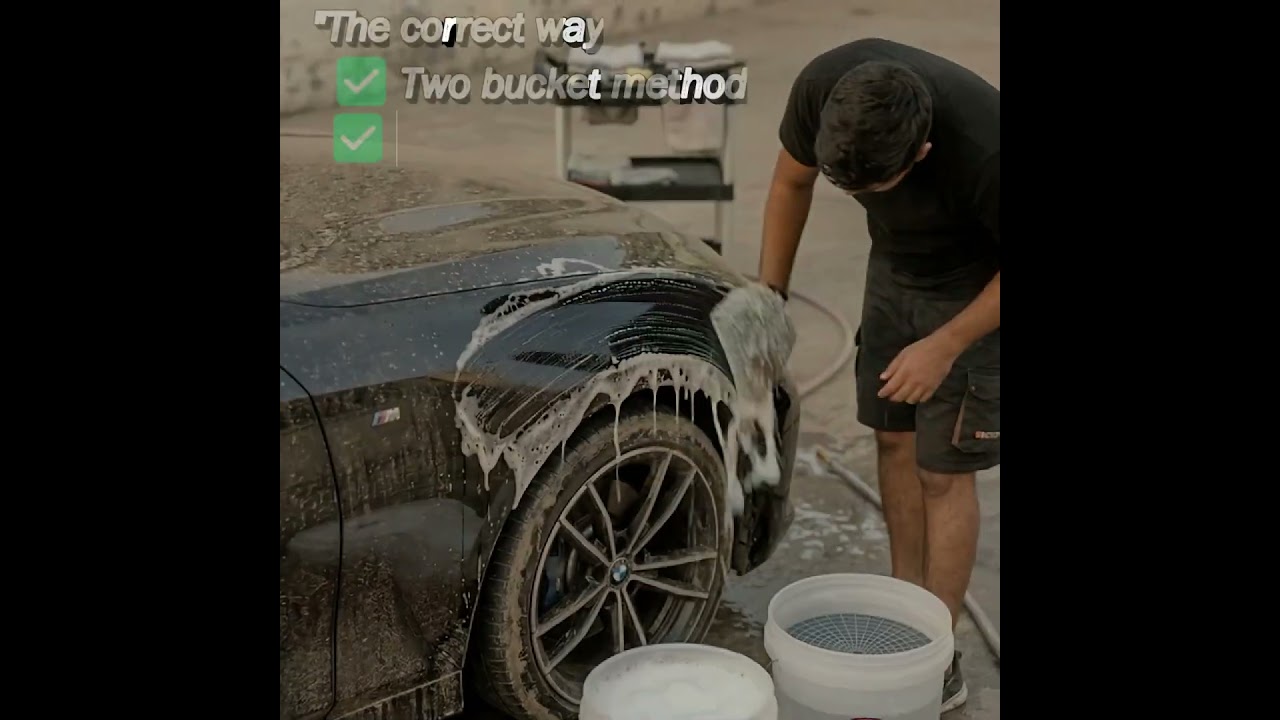 The two-bucket wash method, step by step
It's harder. Dust across North and West India carries a lot of quartz — around 7 on the Mohs hardness scale, far harder than the clear coat on your car. When a harder particle is dragged across a softer surface under pressure, the softer surface always loses. In Rajasthan, Delhi NCR, Punjab and UP, the dust on your car is literally harder than the paint protecting it.
There's more of it. A car parked outdoors in Jaipur or Kota can collect in a few days what a car in a European city collects in weeks. More contamination means more grit transferred to your wash water, faster.
The water is harder too. Tap and borewell water in much of India is high in dissolved minerals, so water left to dry on the paint leaves spots — and on a hot panel, those spots can etch. The table is a rough guide only: supply varies a lot between neighbourhoods of the same city, and an inexpensive TDS meter tells you what your own water is like.
| Area | Typical tap and borewell water | Spot risk while washing |
|---|---|---|
| Jaipur / Kota / Rajasthan | Often very hard, especially borewell water | Very high in summer — dry each panel quickly |
| Delhi NCR | Hard in many areas | High |
| Hyderabad | Hard in many areas, especially borewell supplies | High |
| Bengaluru / Chennai | Varies widely — borewell and tanker water is often hard | Moderate to high |
| Mumbai | Municipal supply is generally softer | Moderate — but sea air adds salt |
How the Two-Bucket Method Works
The principle is almost embarrassingly simple. Bucket one holds your shampoo solution. Bucket two holds plain clean water. After washing each panel, you rinse the mitt in the clean-water bucket — releasing the trapped grit — before reloading shampoo. The dirt goes into bucket two and stays there. Your shampoo water stays clean from the first panel to the last.
Add a grit guard — a plastic grid that sits at the bottom of each bucket — and the released particles sink below the grid where your mitt can't stir them back up. Two grit guards cost ₹400–₹800 in total and make the method noticeably more effective.
The Complete Wash Sequence
Step 1 — Pre-rinse (non-negotiable in India)
Before anything touches the paint, rinse the entire car with running water for a minimum of 90 seconds — longer if the car is visibly dusty. A pressure washer is ideal; a hose works. You're removing most of the loose contamination so your mitt never has to deal with it. If you're cleaning the wheels, do them before this, with their own brushes and mitt, so their grime never reaches your wash buckets. On a typical dusty Indian car, skipping the pre-rinse undoes everything else you do right.
Step 2 — Set up your buckets
Wash bucket: 15–20 litres of water plus pH-neutral car shampoo at the dilution printed on the bottle (usually a capful or two — more shampoo does not mean more cleaning). Rinse bucket: plain water. Grit guard in each.
Step 3 — Wash top-down, panel by panel
Roof → glass → upper doors → bonnet and boot → lower doors → bumpers → sills. Gravity pulls dirty water downward, so you always want to work above the dirt, never through it. The lower third of an Indian car carries the worst contamination — leave it for last, always.
Step 4 — Rinse the mitt after every panel
This is the entire method. Mitt into the rinse bucket, agitate against the grit guard for five seconds, squeeze out, then reload from the shampoo bucket. Panel, rinse, reload. Repeat.
Step 5 — Straight lines, light pressure
Wipe in straight lines following the panel's length — never circles. If a swirl does happen, a straight-line scratch catches light far less visibly than a circular one. Let the shampoo's lubrication do the work; pressing harder only grinds whatever's left on the surface deeper into the paint.
Step 6 — Final rinse and immediate dry
Rinse the whole car, then dry immediately with a large microfiber drying towel — blotting, not dragging. In Indian summer with our dissolved-mineral levels, every minute water sits on a warm panel is a minute minerals are concentrating into future etch marks.
Above 35°C, wash only before 8 AM or after 6:30 PM, and work two panels at a time maximum. Shampoo flash-dries on a 60°C bonnet in under 90 seconds, and dried shampoo plus hard-water minerals is exactly how stubborn water spots form.
What It Costs vs What It Saves
| Item | Price (India) | Lasts |
|---|---|---|
| Second bucket (15–20L) | ₹150–₹300 | Years |
| Grit guards ×2 | ₹400–₹800 | Years |
| Microfiber wash mitt | ₹300–₹800 | 1–2 years |
| pH-neutral shampoo | ₹300–₹800 | 15–30 washes |
| Total entry cost | ₹1,150–₹2,700 | — |
For comparison: professional machine polishing to remove accumulated swirl marks costs ₹3,000–₹8,000 for a hatchback and ₹6,000–₹15,000 for an SUV — and polishing physically removes clear coat, which your car has a finite amount of. The two-bucket method is the cheapest insurance in all of detailing.
The Mistakes That Undo Everything
- Using a sponge. Sponges hold grit against their flat face with nowhere for it to go. A deep-pile microfiber mitt pulls particles up into the fibres, away from the paint. This single swap matters as much as the second bucket.
- Skipping the pre-rinse because the car "doesn't look that dirty." Indian dust is fine enough to be nearly invisible and hard enough to scratch. Rinse anyway.
- Dish soap instead of car shampoo. Dishwashing liquid is made to cut grease, so it strips wax, sealants and the top layer of ceramic coatings and leaves the paint unprotected. A proper pH-neutral shampoo costs about ₹300.
- One towel for everything. The towel that touched your wheels never touches your paint again. Keep wheel cloths physically separate — different colour helps.
- Washing a hot car in the sun. See the summer rule above. Shade or correct timing is part of the method, not optional.
Once two buckets feel routine, add a snow-foam pre-wash before the rinse stage. Foam dwells on the paint and loosens dirt before you touch it, so even less grit ever reaches your mitt. It's the logical next step for dusty-city cars.
Quick Challenge
WashSolvedYour black car is covered in a week of dry dust. What do you do first?
It has been parked outdoors all week. You have two buckets, car shampoo, a wash mitt and a hose.
Remember: Nothing touches dusty paint until the loose grit is gone. Rinse first; a snow foam pre-wash is the next step up.
Read next: Snow foam pre-wash guide
Sources
- Hardness of Water — U.S. Geological Survey. Defines hardness as dissolved calcium and magnesium, expressed as mg/L of calcium carbonate — a different measurement from total dissolved solids (TDS).
Frequently Asked Questions
Does the two-bucket method really prevent swirl marks?
It prevents most of the swirl marks caused by wash technique. Swirls from automatic car washes, dry dusting, or bad towels need their own fixes — but wash-induced swirling, the most common kind in India, drops dramatically.
Can I use the two-bucket method on a ceramic coated car?
You should. Coatings resist chemical etching and UV, not abrasion from grit-loaded mitts. Bad washing will dull and micro-mar a coated car too — the coating just delays the visible damage.
How often should I wash with this method in India?
Every 7 days in high-dust cities (Delhi, Jaipur, Kota, Ahmedabad), every 10–14 days in moderate cities (Mumbai, Bangalore, Pune). In the monsoon, wash at least weekly and rinse the car soon after heavy rain — rain leaves dirt and pollutants behind, and that residue can mark the paint if it bakes on in the sun.